

Need for sustainable aquaculture production, current status\r\nof genome editingThe CRISPR/Cas9 genome editing technology has already been\r\nsuccessfully applied to several aquacultured species, incl...
Need for sustainable aquaculture production, current status\r\nof genome editing
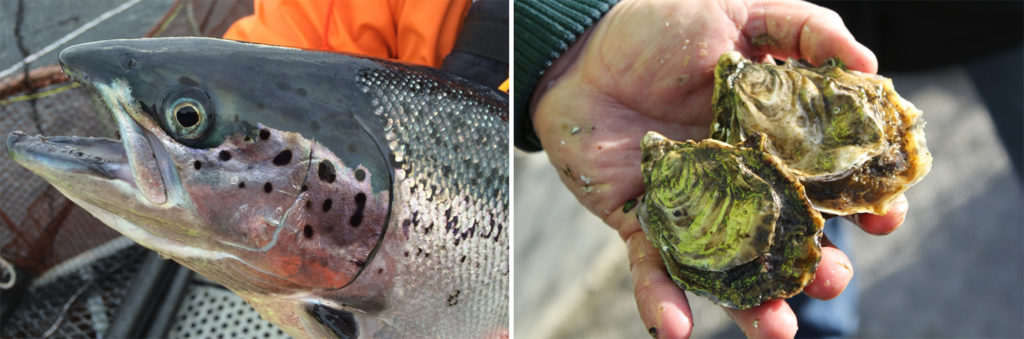
The CRISPR/Cas9 genome editing technology has already been\r\nsuccessfully applied to several aquacultured species, including Atlantic salmon\r\nand Pacific oysters. Photos by Darryl Jory.
The role of\r\naquaculture in food security
Food security is a major and increasing global challenge,\r\nassociated with a rapidly growing demand for high-quality animal protein.\r\nCompetition for land use will present a serious limitation to the scope for\r\nincreases in terrestrial crop and animal production. Therefore, it is likely that\r\naquaculture will have a growing role in meeting this rising food and nutrition\r\ndemand. Fish production via aquaculture is now approximately equal to capture\r\nfishery production for the first time in history, will be the dominant source\r\nof seafood within a few decades, and is the fastest growing food production\r\nsector, predicted to grow by 31 percent over the next 10 years.
Fortunately, development potential is huge, with only ~1\r\npercent of suitable marine sites currently being used for aquaculture. Furthermore,\r\naquaculture production is considered efficient in terms of feed conversion and\r\nprotein retention compared with most terrestrial livestock, and seafood is the\r\nmajor source of long-chain polyunsaturated fatty acids, which are considered\r\nessential for human health. However, relative to many crop and livestock\r\nproduction systems, most aquaculture is at a formative stage and is typically a\r\nhigh-risk activity. Sustainability can be hindered by an initial lack of\r\ncontrol of the reproduction cycles of species, and periodic collapses due to\r\ninfectious diseases. Upscaling and improving the reliability of production will\r\nrequire disruptive innovation in engineering, health, nutrition and genetic\r\nimprovement technologies, the latter being the focus of this review.
Genetic improvement\r\nfor sustainable aquaculture production
Domestication and genetic improvement of terrestrial\r\nlivestock has occurred for several millennia, with organized breeding programs\r\nfor most species in place for more than 50 years. The results have been\r\nstriking; for example, selective breeding has led to a threefold increase in\r\nthe efficiency of milk production in cows, with similar gains for other target\r\ntraits. By contrast, relatively little aquaculture production is underpinned by\r\nmodern selective breeding programs.
Most farmed aquatic species are either still sourced from\r\nthe wild or in the early stages of domestication, suggesting that there is\r\nsubstantial standing genetic variation for traits of economic importance. The\r\nreproductive biology of aquatic species can be amenable to the application of genetics\r\nand breeding technologies, enabling high selection intensity and, therefore,\r\ngenetic gain. In part, this is due to the near-universal high fecundity of\r\naquatic species, and the resulting large nuclear families, which can facilitate\r\nextensive collection of phenotypic records in close relatives (including full\r\nsiblings) of selection candidates in breeding programs.
The reproductive output from genetically improved broodstock\r\ntogether with ease of transport of eggs and juveniles, also means widespread dissemination\r\nof improved stocks can have a rapid impact on production. Furthermore, with the\r\ndevelopment of high-density SNP arrays [a SNP array is a microarray platform\r\nthat provides the genotype of an individual for many thousands of SNPs (single\r\nbase-pair differences in DNA sequence at a specific region of the genome)\r\ndispersed throughout the genome] and routine genotyping by sequencing genomic\r\nselection – the use of genome-wide SNPs to predict breeding values of selection\r\ncandidates in a selective breeding program and to help inform which individuals\r\nto select for breeding – has become the state-of-the-art in several globally\r\nimportant aquaculture sectors, offering higher selection accuracies than\r\nselection based on phenotypic and pedigree records alone.
However, genetic progress in selective breeding is limited\r\nby the heritability of the target traits, the generation interval of the\r\nspecies and the need to target multiple traits in the breeding goal. In\r\naddition, advanced breeding programs are typically closed systems, and are\r\nlimited to the standing genetic variation in the broodstock (typically sourced\r\nfrom a limited sample of wild populations), and new variation that arises from\r\nde novo mutations. Genome-editing technologies – such as CRISPR/Cas9 (CRISPR\r\nstands for clustered regularly interspaced short palindromic repeats and Cas9\r\nstands for CRISPR-associated protein 9 (CRISPR sequences together with the Cas9\r\nenzyme can be used to make targeted changes to a genome) – offer new solutions\r\nand opportunities in each of these areas.
Advances in\r\ngenome-editing technologies: CRISPR/Cas9 as the game-changer
In contrast to transgenesis, which involves the transfer of\r\na gene from one organism to another, genome editing allows specific, targeted\r\nand often minor changes to the genome of the species of interest. Initial\r\nprogress using other technologies has been largely superseded by the advent of\r\nthe repurposed CRISPR/Cas9 system. The CRISPR/Cas9 system was discovered in\r\nbacteria, and was engineered to enable easy, cheap and efficient targeted\r\nediting of the genome. The system enables imperfect or targeted repair to\r\ncreate alterations to the sequence of the genomic DNA.
There are two primary repair mechanisms, each of which can\r\nbe used to introduce different types of edit to the target genome. First, the\r\ntwo adjacent strands of DNA can be repaired through a technique called\r\nnonhomologous end-joining pathway (NHEJ), which is error-prone and induces\r\ninsertion or deletions of a few nucleotides. Second, if a repair template is\r\npresent, another technology called homology-directed repair (HDR) can be used\r\nto insert desired mutations (from a single nucleotide swap to a whole\r\nchromosomal region insertion).
Over the past few years, technical developments have made\r\ngenome editing more efficient and raised new possibilities for biological\r\ndiscovery. There have also been numerous innovations that have enabled improved\r\nprecision of editing, with lower off-target rates, and broadening of the range\r\nof target sites accessible via alternative Cas9 proteins. Novel extensions of\r\nthe CRISPR/Cas9 editing system now allow researchers to better achieve gene\r\nactivation or inhibition, and some techniques have the potential to target\r\nalmost two-thirds of human SNPs.
Current status of\r\ngenome editing in aquaculture species
Genome editing using CRISPR/Cas9 was recently successfully\r\napplied in vivo and/or in cell lines of several major aquaculture species like\r\nAtlantic salmon and rainbow trout); carps (Rohu, grass, and common carp);\r\nchannel and southern catfish), as well as Pacific oyster, Nile tilapia and\r\ngilthead sea bream (Table 1). One major group of aquatic species where\r\nsuccessful CRISPR/Cas9 editing has not yet been reported is shrimp (Penaeus sp.),\r\nwhich may be partly due to practical limitations, as discussed briefly below.
Most studies have a proof-of-principle focus, have typically\r\nfollowed CRISPR/Cas9 protocols developed in model organisms – such as zebrafish\r\n–and have often targeted genes with a clearly observable phenotype to test\r\nediting success (e.g., pigmentation). The standard methodology to induce in\r\nvivo mutations in aquaculture species is injection of the CRISPR/Cas9 complex\r\ninto newly fertilized eggs as close as possible to the one-cell stage of\r\ndevelopment. Typically, mRNA encoding the Cas9 protein is injected together\r\nwith the guide (g)RNA, leading to a high efficiency of editing that has been\r\ndemonstrated in various species to date ; using the Cas9 protein in\r\nplace of mRNA is also effective.
Target production traits for genome-editing studies in\r\naquaculture species to date have included sterility, growth, and disease\r\nresistance. Creating sterile animals for aquaculture is desirable to prevent\r\nintrogression with wild stock and to avoid the negative production consequences\r\nof early maturation. In this context, CRISPR/Cas9 has been used to induce\r\nsterility in Atlantic salmon and catfish. For growth-associated traits, several\r\ngroups have edited the myostatin gene (famous for its role in double-muscled\r\ncattle, such as the Belgian Blue), resulting in larger fish. To date, this has\r\nbeen performed in channel catfish and common carp. Immunity and disease\r\nresistance have already been investigated using genome editing in rohu carp and\r\ngrass carp, respectively, and it is expected that this area of research will\r\nflourish as a route to improving and understanding disease resistance as a key\r\ntarget trait for aquaculture.
Genome editing can also be applied to develop models for\r\nstudying fundamental immunology, such as the targeted disruption of the TLR22\r\ngene in carp. Such models can improve our fundamental understanding of host\r\nresponse to infection in fish and may lead to more effective treatment\r\nprotocols. Along similar lines, it is plausible to use genome-editing\r\ntechnology to generate improved cell lines for fish species, for example by\r\nenabling more efficient production of viruses for future vaccine development by\r\nknocking out key components of the interferon pathway.
Genome editing to\r\ninduce sterility and prevent wild introgression in Atlantic salmon: A case\r\nstudy
Most Atlantic salmon are farmed in open sea-cages, a\r\nproduction method that faces sustainability challenges, such as disease\r\ntransmission from wild to farmed fish and vice versa, as well as escaped farmed\r\nfish impacting wild populations. A possible solution to these problems is the\r\ncreation and use of sterile salmon in production. Currently, the only method\r\navailable to sterilize commercial-scale numbers of salmon is triploidization\r\n(production of animals with three copies of every chromosome instead of the\r\nnormal two). However, triploid (infertile) salmon are generally more sensitive\r\nto suboptimal rearing environments, which can make them prone to deformities\r\nand less tolerant to rising seawater temperatures.
There are two significant additional benefits of using\r\nsterile fish. First, early maturation is prevented, which avoids the associated\r\nnegative phenotypes, such as reduced growth, lower flesh quality and higher\r\nsusceptibility to disease. Second, sterility in production fish may safeguard\r\nIntellectual Property for the breeding companies. The gene encoding dead end\r\n(dnd) has been targeted to induce sterility in salmon, preventing the formation\r\nof germ cells. This was done using targeted mutagenesis (a process that changes\r\nthe genetic information of an organism, resulting in a mutation) against dnd\r\nwith CRISPR/Cas9, thereby creating a gene-edited sterile fish. Germ cell-free\r\nsalmon will be 100 percent sterile and do not enter maturity.
Practical application of such sterile fish in breeding\r\nprograms will require developments in genome editing, including knock-in, which\r\ncould lead to the production of an inducible on-off system for sterility. Such\r\nmechanisms have been developed for the model fish species medaka and zebrafish.\r\nUse of this sterility technology may foster the future development of genome\r\nediting for other traits, such as disease resistance, with negligible risk of\r\nescapees interbreeding and passing edited alleles (variant forms of a given gene)\r\non to wild stocks.
Some practical reasons why genome editing has such potential\r\nfor research and applications in aquaculture species are the ease of access to\r\nmany thousands of externally fertilized embryos, and the large size of those\r\nembryos facilitating microinjection by hand. The ability to use large nuclear\r\nfamilies enables a degree of control of background genetic effects, with ample\r\nsample sizes achievable for downstream comparisons of successfully edited\r\nindividuals with their unedited full-sibling counterparts. The ability to\r\nperform extensive “phenotyping” is often also feasible, for example using\r\nwell-developed disease challenge models to assess resistance to many viral and\r\nbacterial pathogens during early-life stages. Finally, should favorable alleles\r\nfor a target trait (e.g., disease resistance) be created or discovered, then\r\nthere is potential for widespread dissemination of the improved germplasm for\r\nrapid impact via the aforementioned selective breeding programs.
In parallel, high-quality, well-annotated reference genomes\r\nare available for most of the key species. A high-quality species-specific\r\nreference genome is essential for the effective design of target guide RNAs\r\n(gRNA; one of two components of engineered CRISPR systems) with high specificity\r\nand minimum change of off-target editing, in particular given the relatively\r\nrecent whole-genome duplication events that are features of several finfish\r\nlineages, including salmonids.
Integration of\r\ngenome-editing technologies into aquaculture breeding and dissemination\r\nprograms
If the public and regulatory landscape permits,\r\ngenome-editing technologies are likely to be used in commercial aquaculture\r\nbreeding in the coming years. However, for widespread adoption, maximal\r\nbenefit, and minimal risk, it is necessary that these technologies are\r\nseamlessly integrated with well-managed selective-breeding programs. Achieving\r\nthis will help ensure careful management of genetic diversity and avoidance of\r\npotential inbreeding depression.
In practice, the mass delivery of CRISPR/Cas9 to edit production\r\nor multiplier animals is unlikely to be feasible, and editing entire broodstock\r\npopulations to carry the desirable alleles in the germplasm (living genetic\r\nresources like seeds or tissues that are maintained for the purpose of animal\r\nand plant breeding, preservation, and other research uses) is more practical.\r\nAs such, inducible editing targets may be required for impacts on traits\r\nrelated to sterility and maturation.
In addition, technology developments are required to\r\neffectively integrate multiple edits simultaneously into broodstock animals to\r\ntarget multiple traits, or multiple causative alleles for the same trait.\r\nThorough testing of edited animals is required to assess and exclude\r\npossibilities of unintended and potential detrimental pleiotropic effects of\r\nedits before any application in production.
However, once these issues have been addressed, widespread\r\nand rapid positive impacts could be achieved, because the high fecundity of\r\nmost aquaculture species may enable dissemination to production systems without\r\nthe need for pyramid breeding schemes typical of terrestrial livestock species.
Applications of\r\ngenome editing for aquaculture research and production
Infectious diseases are one of the primary threats to\r\nsustainable aquaculture, with an estimated 40 percent of the total potential\r\nproduction lost per annum. Due to the formative stage of domestication of many\r\naquaculture species, new selection and disease pressures in the farm\r\nenvironment may increase the possibility that standing genetic variation in\r\nfarmed populations includes loci of major effect, which may represent potential\r\nlow-hanging fruit for genome editing to increase the frequency of the favorable\r\nallele.
A well-known example of a major quantitative trait locus\r\n[QTL; a locus (section of DNA) which correlates with variation of a\r\nquantitative trait in the phenotype of a population of organisms]; often an\r\nearly step in identifying and sequencing the actual genes that cause the trait\r\nvariation.) affecting disease resistance is the case of infectious pancreatic\r\nnecrosis virus (IPNV) in Atlantic salmon, in which a major QTL explains the\r\nmajority of the genetic variation. Marker-assisted selection, based on the\r\ntargeted use of molecular genetic markers, has been successfully applied to markedly\r\nreduce the impact of this disease.
However, despite several QTL studies in aquaculture species\r\nand ample evidence for the heritability of disease resistance traits, only a\r\nhandful of large-effect QTL have been detected, and most disease resistance and\r\nother production-relevant traits are underpinned by a polygenic (multiple\r\ngenes) genetic architecture. As such, genetic improvement of disease resistance\r\nrelies on family-based selective breeding programs, augmented by the use of\r\ngenomic selection, for which disease resistance has been a major focus.
\r\n\r\n\r\n\r\n\r\n\r\n\r\n\r\n\r\n\r\n\r\n\r\n\r\n\r\n\r\n\r\n\r\n\r\n\r\n\r\n\r\n\r\n\r\n\r\n\r\n\r\n\r\n\r\n\r\n\r\n\r\n\r\n\r\n\r\n\r\n\r\n\r\n\r\n\r\n\r\n\r\n\r\n\r\n\r\n\r\n\r\n\r\n\r\n\r\n\r\n\r\n\r\n\r\n\r\n\r\n\r\n\r\n\r\n\r\n\r\n\r\n\r\n\r\n\r\n\r\n\r\n\r\n\r\n
The substantial opportunity for genetic improvement of\r\ndisease resistance and other performance traits in aquaculture species,\r\ncombined with initial success of in vivo genome-editing trials, opens exciting new\r\navenues to improve aquaculture production and sustainability. There are three\r\nmain categories by which genome-editing technology could be applied to make\r\nstep changes in genetic improvement, and each requires different approaches to\r\nthe underpinning research leading to discovery of functional alleles: (i)\r\ndetecting, promoting, removing, or fixing targeted functional alleles at single\r\nor multiple QTL(s) segregating within current broodstock populations of a\r\nselective breeding program; (ii) targeted introgression-by-editing of favorable\r\nvariants from different populations, strains, or species to introduce or\r\nimprove novel traits in a population; and (iii) creating and utilizing de novo\r\nfavorable alleles that are not known to exist elsewhere. We discuss each of\r\nthese avenues, and a unique opportunity to harness a combination of in vivo and\r\nin vitro approaches to understand and improve disease resistance in aquaculture\r\nspecies is presented.
Source : Global Aquaculture Alliance

Ditulis oleh
Tim Minapoli
Kontributor
Pakar di bidang akuakultur dengan pengalaman lebih dari 15 tahun. Aktif berkontribusi dalam pengembangan industri perikanan Indonesia.