

This scanning electron micrograph (SEM) depicts a number of Vibrio parahaemolyticusbacteria (Mag.\r\n19058x), a serious pathogen in the seafood and other food industries. Photo by\r\nCDC/Janice Carr. ...
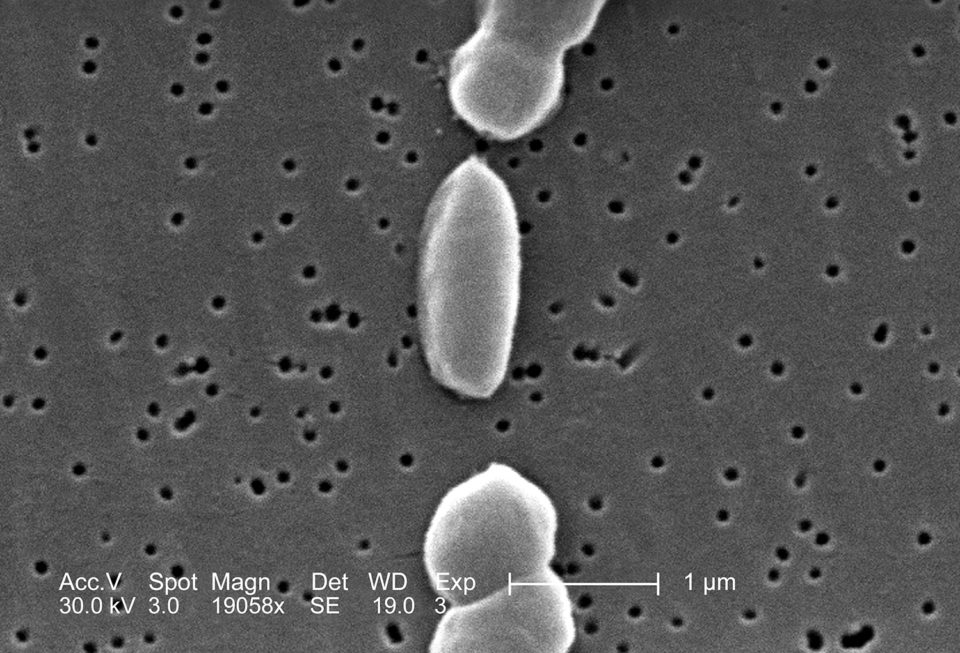
This scanning electron micrograph (SEM) depicts a number of Vibrio parahaemolyticusbacteria (Mag.\r\n19058x), a serious pathogen in the seafood and other food industries. Photo by\r\nCDC/Janice Carr. Public domain.
The bacterium Vibrio\r\nparahaemolyticus is naturally present in brackish coastal environments\r\nand is frequently isolated from a variety of seafood. This bacterium is a major\r\nseafood-borne pathogen that causes gastrointestinal disorders due to ingestion\r\nof raw or undercooked seafood it contaminates. In recent years, outbreaks\r\nof V. parahaemolyticus infections\r\nhave been a significant public health concern in many countries. Additionally,\r\nthe number of V. parahaemolyticus infections\r\nhas increased, and their reach has widened globally during recent years.
People infected with V. parahaemolyticus are characterized by an acute\r\ngastroenteritis disorder with clinical signs of diarrhea, headache and\r\nvomiting. Low immunity populations who become infected with V. parahaemolyticus may develop\r\nsepticemia in severe cases. Controlling the amount of V. parahaemolyticus in seafood is an effective way to prevent\r\ninfection by this pathogen; therefore, it is important to determine the levels\r\nof V. parahaemolyticus in\r\nseafood.
Early and rapid diagnosis is crucial for the management\r\nof V. parahaemolyticus infection.\r\nDifferent diagnostic methods for V.\r\nparahaemolyticus infection have been reported. Conventional culturing\r\nand immunological methods are common techniques used for V. parahaemolyticus detection.\r\nHowever, they are time-consuming and take a few days to provide a confirmed\r\nresult after numerous analytical steps.
Advancements in biotechnology have led to the development of\r\na number of gene amplification-based molecular detection technologies for V. parahaemolyticus, with varying\r\ndegrees of sensitivity and specificity. These include polymerase chain reaction\r\n(PCR) and others. However, these tests can be impractical for on-site\r\napplication due to the expensive instruments required and time-consuming\r\noperation. A simple, rapid, accurate and user-friendly platform is still needed\r\nfor the early point-of-need (POD) detection of V. parahaemolyticus infection.
Recombinase polymerase amplification (RPA), a novel\r\nisothermal gene amplification technique, has been demonstrated to be a simple,\r\nrapid, specific, sensitive and cost-effective molecular assay to identify\r\ndiverse pathogens. The RPA process for exponential amplification of the target\r\nsequence can be achieved in 20 minutes or less.
This article – adapted and summarized from the original\r\npublication [Geng, Y. et al. 2019. Development and evaluation of a rapid\r\nand sensitive RPA assay for specific detection of Vibrio parahaemolyticus in seafood. BMC Microbiol 19, 186 (2019) –\r\ndescribes a study to develop and evaluate a real-time RPA method for the simple\r\nand rapid detection of V.\r\nparahaemolyticus.
Study setup
A total of five V.\r\nparahaemolyticus strains, five other Vibrio species and 22 other\r\nbacterial strains were used to determine the specificity of the real-time RPA.\r\nFor detailed information on the bacterial strains and their DNA extraction; RPA\r\nprimers and probe; Real-time RPA reaction; real-time PCR for V. parahaemolyticus; specificity and\r\nanalytical sensitivity analysis; evaluation with artificially contaminated\r\nsamples; and statistical methods used, refer to the original publication.
This work was supported by the program of scientific\r\nresearch foundation in Universities of Hebei Province (QN2019025, Hebei,\r\nChina); the General Administration of quality supervision, inspection and\r\nQuarantine of the People’s Republic of China (2016IK107, China); and the\r\nBiology postdoctoral Science of Hebei Normal University (183717, Hebei, China).
Results and\r\ndiscussion
The real-time RPA reaction was performed successfully at 38\r\ndegrees-C, and results were obtained within 20 minutes. The method only\r\ndetected V. parahaemolyticus and\r\ndid not show cross-reaction with other bacteria, exhibiting a high level of\r\nspecificity. The study showed that the detection limit (LOD) of real-time RPA\r\nwas 1.02 × 10² copies/reaction.
For artificially contaminated samples with different\r\nbacteria concentrations, V.\r\nparahaemolyticus could be detected within 5 to 12 min by real-time RPA in\r\noyster sauce, codfish and sleeve-fish at concentrations as low as 4 Colony\r\nForming Units (CFU)/25 g, 1 CFU/25 grams and 7 CFU/25 grams, respectively,\r\nafter enrichment for 6 hours, but were detected in a minimum of 35 minutes by\r\nreal-time PCR [with Ct (cycle threshold) values between 27 and 32; in a real\r\ntime PCR assay, a positive reaction is detected by accumulation of a\r\nfluorescent signal. Ct the number of cycles required for the fluorescent signal\r\nto cross the threshold, to exceed the background level].
In recent years, diseases caused by food-borne pathogens\r\nhave become a significant global public health issue. V. parahaemolyticus is one of the major pathogens causing\r\nfood-borne illness, and contamination of food products with this pathogen has\r\nbecome a vital concern for food safety. Therefore, there was a need for rapid,\r\nspecific and reliable diagnostic techniques that can be used effectively for\r\nbetter detection of V.\r\nparahaemolyticus in seafood, environmental and other various sample\r\ntypes.
In our study, we successfully established the real-time RPA\r\nassay targeting a specific gene of V.\r\nparahaemolyticus. Conventional RPA was successfully performed at\r\n38 degrees-C and was completed within 20 minutes. The sensitivity of the\r\nreal-time RPA assay was examined using serial dilutions of V. parahaemolyticus genomic DNA\r\ntemplate. The limit of detection of the real-time RPA assay was 102\r\ncopies/reaction.
While the V.\r\nparahaemolyticus detection results by real-time RPA could be obtained\r\nin approximately 30 minutes, including the time for nucleic acid extraction,\r\nthe reaction time for positive samples reached up to 1 hour when using\r\nreal-time PCR. In addition, the real-time RPA assay was also successful in the\r\ndetection of artificially contaminated seafood samples, and it performed better\r\nthan real-time PCR with respect to detection speed.
For the real-time RPA assay described in this study, V. parahaemolyticus could be\r\ndetected in artificially contaminated samples at concentrations as low as\r\n1 CFU/25 grams within 12 minutes. Compared to other isothermal amplification\r\ntechniques, RPA does not require initial heating for DNA denaturation and\r\nresults can be obtained in less than 12 minutes which didn’t include the\r\nenrichment time. The real-time RPA assay has multiple advantages over other DNA\r\namplification methods, including a quicker time-to-result for a single sample\r\nand others.
RPA has been widely explored for the molecular detection of\r\ndiverse pathogens, and field testing has also been achieved for Dengue virus\r\nand avian influenza A virus infection. Moreover, the portable tube scanner used\r\nin the study, weighing only 1.75 kg with dimensions of\r\n25 cm × 16.5 cm × 8.5 cm, is simpler than most real-time PCR machines and can\r\nbe used in the field, running on battery power for an entire day.
Perspectives
In this study, we successfully developed a real-time RPA\r\nmethod based on an exo-probe for the detection of V. parahaemolyticus. With high sensitivity and specificity, the\r\nassay could be completed within 20 min and the approach is easy to perform in\r\nclinical settings without a requirement for sophisticated equipment, which\r\nrenders it applicable at quarantine stations, ports of importation or sites of\r\noutbreaks.
\r\n\r\n\r\n\r\n\r\n\r\n\r\n\r\n\r\n\r\n\r\n\r\n\r\n\r\n\r\n\r\n\r\n\r\n\r\n\r\n\r\n\r\n\r\n\r\n\r\n\r\n\r\n\r\n\r\n\r\n\r\n\r\n\r\n\r\n\r\n\r\n\r\n\r\n\r\n\r\n
The effective and rapid real-time RPA assay developed in\r\nthis study would be highly useful in the monitoring of V. parahaemolyticus infection and\r\nhas the potential to be a promising alternative to real-time PCR and other\r\nisothermal methods for rapidly testing V.\r\nparahaemolyticus infection, a significant risk in the seafood and\r\nother industries.
Source: Global Aquaculture Alliance

Ditulis oleh
Tim Minapoli
Kontributor
Pakar di bidang akuakultur dengan pengalaman lebih dari 15 tahun. Aktif berkontribusi dalam pengembangan industri perikanan Indonesia.